
Talent Data Intelligence
The strategy is clear. Can the organisation carry it?
andEnergy provides well-founded data on what people and teams bring by nature, and sets it against what the strategic challenge demands. This makes risks in decision-making, collaboration and execution visible before they show up in the results. How does it work?
Back to the source
Almost everything we know about people is measured after work and organisation have already shaped them.
Experience, competencies, appraisals and engagement scores are valuable, but they measure the outcome of years of interaction between people and organisation. Decisions that rest on these data alone stay within existing frameworks.
andEnergy adds an earlier layer: the natural drives and thinking styles of people and teams. These are relatively stable, and therefore a reliable starting point for decisions that reach beyond the current situation.
What is this based on?
The foundation is the Talent Passport by Pontis. The instrument was developed in collaboration with the University of Antwerp and psychometrically validated for internal consistency, test-retest reliability, construct validity and external validity.
The method
Two realities. First separately. Only then side by side.
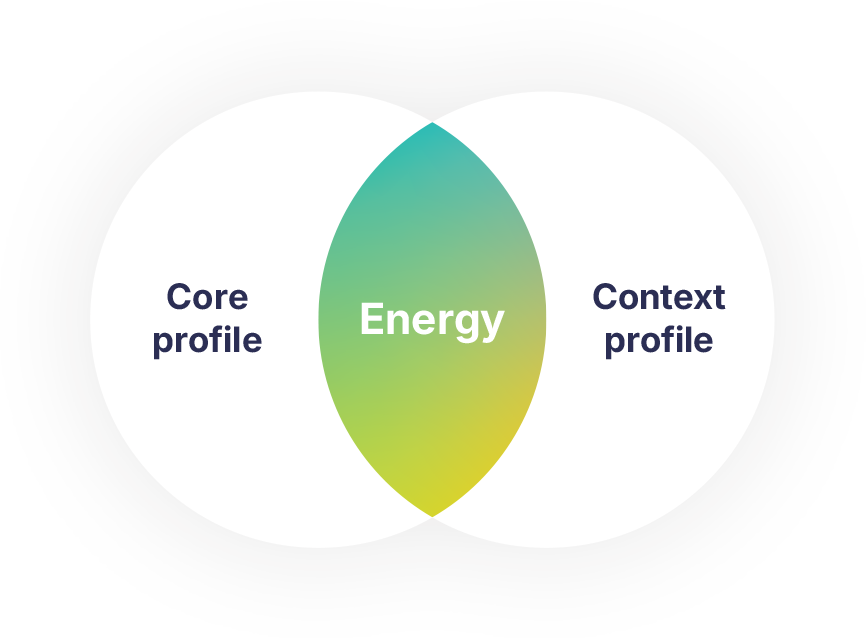
People and challenge are described separately. That way, the assignment is not coloured by what is already known about people, and people are not judged against an unclear assignment. The measurement is the basis, not the product: we do not assess people, we interpret the fit between people and work.
Core Profile
What is present?
Drives and thinking styles per person. For teams, also the collective patterns and their spread.
Context Profile
What does the work demand?
Assignment, context and the result that must demonstrably be achieved. Including ownership, scope and preconditions.
Match and Energy Analysis
What emerges from the comparison?
A fixed comparison shows where there is a fit, and where the challenge structurally calls for extra energy, complementary strengths or a different design.
Energy is about what work gives or costs someone. When work fits what is naturally present, it gives energy; when it does not, it takes effort. In the short term, performance often holds up; with a structural mismatch, the energy balance deteriorates, with consequences for pace, decision-making and continuity.
Four patterns
The same result.
A different
energetic cost.
Two teams can reach the same goals: one from natural fit, the other through prolonged compensation. That difference matters, because it determines how sustainable the result is.
The assignment draws on natural qualities.
— How do we safeguard these conditions?
Qualities are available, but hardly called upon.
— Where does capacity go unused?
Qualities are present, but the context hinders their use.
— Which precondition needs to change?
The contribution is delivered, but requires prolonged conscious adaptation.
— Develop, complement or redesign?
From practice
Leadership team
A strong team that can get stuck through its own strength
A team with plenty of natural energy for direction, results and sharp choices. When a distinctly inventive thinking style is added, the capacity to explore grows. At the same time, there is a risk that strong decisiveness closes down that exploration too early. The Context Profile first tests whether the strategic assignments are sharp and whether they align. Only then does it become clear where the team’s strength fits, where the design needs to help, and what complementary strengths may be needed.
Core Profile → Context Profile → Match → Energy Analysis → Team design
Intended outcomes
A team that carries its strategic challenge from natural strength, with clear decision rights, room for exploration before the decision, and targeted complementary strengths where needed.
Education
A learning pathway that starts with what the student already brings
At intake, the Talent Passport maps what each student brings by nature. The occupations the programme prepares for are described as occupational contexts. A fixed comparison shows for each student which ones fit best, without any judgement of suitability. The personal development plan combines this with the curriculum and with what the student can already do. This makes visible where learning comes naturally and where it demands extra effort, from the student or from the learning environment.
Core Profile → Occupational contexts → Match → Energy Analysis → Personal learning pathway
Intended outcomes
Students complete their programme at a learning and work placement that fits their energy. Support signals are recorded in advance as testable hypotheses and monitored, so that adjustments can be made in time.
Labour market
Talent that falls through the cracks
Many neurodivergent people have an education or work experience, but cannot find work that fits or get stuck in their job. They fall between agencies. That is why we start not from a diagnosis or a vacancy, but from what someone brings by nature. We do not ask employers for a vacancy, but for a role or assignment that we explore together. Participants stay in control: they take the first step and decide whether to take part.
Core Profile → Context Profile → Match → Energy Analysis → Work that fits
Intended outcomes
Sustainable work in a place where talent comes into its own, with support both in finding work and while in work. Employers see which context activates these qualities.
Broad applicability
One line of reasoning, four levels.
The same sequence works for one person, a team, an organisation and a collaboration across organisational boundaries: first describe what is there and what the challenge demands, then compare and design.
Individual
Role, position and development aligned with what someone brings by nature.
Team
Composition, division of roles and decision-making aligned with collective patterns.
Organisation
Strategy, structure and change programmes tested against the available natural capacity.
Ecosystem
Complementary qualities in collaborations across organisational boundaries.


Get started
Start with one question.
Decision projects
One well-defined question about strategy, team composition, reorganisation, intake or collaboration across organisational boundaries. Often the starting point for an organisation-wide roll-out.
Organisation-wide roll-out
Talent Passport and Context Profile used structurally throughout the organisation: at intake, in work-based learning, internal mobility and change programmes. To gain earlier insight into fit and design questions.
A validated measurement
The Talent Passport measures natural drives and thinking styles reliably and against norms. It describes what someone brings by nature and is not a psychological diagnosis.
A foundation for decisions
Testable in your context

Training to become Practitioner, Expert and Master
Participants learn to connect talent data to the Real Dialogue, context interpretation, energy analysis and design questions.
For more information about the training programmes, please contact henny@andenergy.nl or +31 (0)6 55 14 00 86.